MARVEL MARATHON DEEP DIVE
THE
PUNISHER.
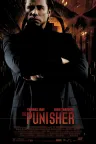
Jonathan Hensleigh, a screenwriter making his directorial debut, shot The Punisher as Lions Gate bought out the studio financing it, then split critics over how dark versus campy the finished film played.
A CHARACTER MARVEL HAD ALREADY TRIED ONCE
WHY THIS PUNISHER OWES NOTHING TO THE ONE FROM 1989
Marvel had tried a Punisher film once before, fifteen years earlier. Dolph Lundgren played Frank Castle in a 1989 adaptation that New World Pictures, in financial trouble at the time, sent straight to home video in the United States instead of into theatres. It still turned a profit there, reportedly earning around $30 million in VHS and laserdisc sales against a $9 million budget, but it left Castle without his signature skull, since the rights the production held didn’t extend to the logo. Nothing carries over between the two films: no returning cast, no shared continuity, just a fifteen-year gap in which the character barely existed as a viable one.
Artisan Entertainment and Marvel Enterprises set the 2004 film in motion together in April 2002. Jonathan Hensleigh, primarily known up to that point as a screenwriter, signed on to both write and direct, his first time doing the latter.
The company financing the film didn’t survive to release it under its own name. On 27 October 2003, while The Punisher was still in production, Lions Gate Entertainment announced it was buying Artisan outright for $160 million in cash plus the assumption of more than $60 million in debt. Artisan chief executive Amir Malin folded the still-unfinished film directly into the pitch for the deal, telling the trade press the combined company would enter 2004 with “franchise properties like Dirty Dancing: Havana Nights and Marvel’s incredible comic book legend The Punisher.” The film opened under the Lions Gate banner the following April, a studio that hadn’t owned the project when cameras first rolled on it.
A SCREENWRITER DIRECTING FOR THE FIRST TIME
JONATHAN HENSLEIGH ON TRADING DIE HARD AND ARMAGEDDON FOR A DIRECTOR’S CHAIR
Before The Punisher, Hensleigh’s name was attached to some of the biggest action scripts of the previous decade: Die Hard with a Vengeance and Jumanji, both released in 1995, then Armageddon in 1998. None of that work had put him behind a camera. He wrote this screenplay himself, drawing heavily on Garth Ennis’s comics: “I was very heavily influenced by Garth Ennis’ Welcome Back Frank,” Hensleigh has said. “That’s where I took the tenement apartment, the characters of Spacker Dave, Joan the Mouse, Mr. Bumpo and the Russian.”
“It was violent, tense and real, but it had a kind of jaunty, light-on-its-feet, droll tone.”
Jonathan Hensleigh, on the tone he was aiming for
Elsewhere he was blunter about how hard that balance was to hold onto, calling a consistent tone “one of your greatest obstacles, one of your greatest challenges” on the production, and insisting the finished film wasn’t as brutal as its reputation suggests: “I’m not a fan of gratuitous violence, and there isn’t a river of blood in this film.” Asked what the biggest challenge of a first-time director’s job actually was, he didn’t point to inexperience: “The challenge wasn’t about being a first time director, it was handling the scale of this production in a 52-day schedule, on the budget that I had.”
THE ROLE THOMAS JANE TURNED DOWN AT FIRST
WHAT CHANGED HIS MIND, AND HOW FAR HE WENT TO PREPARE
Jane had read comics since childhood but wasn’t particularly familiar with the Punisher, and turned the part down when producer Avi Arad first offered it to him. What changed his mind was Arad’s own explanation of who the character actually was: “He had to explain to me that this was not a super hero and didn’t have super powers and can’t climb walls or shoot lasers out of his eyes, or funky stuff. This guy was just a regular guy who relied on his God-given talents and his wits to overcome his enemies.”
Once he committed, Jane trained for six months before a single scene was shot, working with Navy SEALs on hand-to-hand combat and weapons handling alongside a program built to add muscle to his frame. “It was six months of training,” he said. “It took up every hour of my time, and then three months of shooting.” He described the intensity bluntly: “They came over to my house every day, and they beat me with a stick, until I submitted to their will.”
A VILLAIN PLAYED STRAIGHT IN A FILM THAT WASN’T
JOHN TRAVOLTA’S HOWARD SAINT, AND THE TONE CRITICS COULDN’T PIN DOWN
Artisan and Marvel announced John Travolta as Howard Saint, the crime boss who orders Castle’s family killed, in May 2003. “John has proven through his career that he can inject into the most villainous roles an energy and humanity that registers with audiences,” Avi Arad said at the time, pointing to Travolta’s earlier turns in Pulp Fiction, Broken Arrow and Face/Off as the template.
What Travolta played straight, the film around him didn’t always match. The finale stages Castle and Saint in a quick-draw Western standoff before Castle straps the dying Saint to a car and detonates it in a parking lot wired with explosives, and an earlier set piece pits Castle against a hulking assassin called the Russian, played by wrestler Kevin Nash, in a fight built as much for laughs as for menace, complete with a live grenade batted back through a window. That gap left critics arguing over whether the film was too dark or too campy rather than agreeing on either.
THE REWATCH
A MODEST OPENING, A HARSH SCORE, AND A ROLE THOMAS JANE KEPT COMING BACK TO
The Punisher opened on 16 April 2004 to $13.8 million from 2,649 theatres on a $33 million budget, finishing second for the weekend behind Kill Bill: Volume 2’s $25.6 million debut. It closed its run with $33.8 million domestic and $54.7 million worldwide, a modest result that ended any immediate plans for a sequel with Jane attached. Reviews were unkind: Rotten Tomatoes lists a 30% critics’ score against a 63% audience score, and Metacritic’s aggregate sits at 33.
Jane didn’t leave the role behind. In 2012, eight years after the film and with no studio involved, he reprised Frank Castle for The Punisher: Dirty Laundry, a ten-minute short produced by Adi Shankar and directed by Phil Joanou, made independently rather than through Marvel or any distributor. Jane called it “a fan film for a character I’ve always loved and believed in, a love letter to Frank Castle and his fans.”
Looking back on his own performance since, Jane has been unsentimental about the physical mismatch between himself and the character as written. “I was miscast as Frank Castle,” he said. “He’s an Italian. He’s got black hair and a whole different sort of lineage. I had to dye my hair black and become a different guy.” He has also said he’s glad the role eventually passed to Jon Bernthal: “I’m happy the part is played by someone who is more right for that role. I had fun, and I did the best I could with it.” For a first watch, this Punisher sits in the Marvel movies in release order guide directly after Hulk, unconnected to either the 1989 Lundgren film before it or the Punisher: War Zone reboot four years later.
QUICK ANSWERS
THE PUNISHER WATCH QUESTIONS
Do I need to watch anything before The Punisher?
No. It’s a self-contained origin story with no ties to any earlier or later Punisher adaptation.
Is this connected to the 1989 Punisher film or 2008’s Punisher: War Zone?
No. The 1989 Dolph Lundgren film and 2008’s Punisher: War Zone, with Ray Stevenson, are unrelated productions with different casts and no shared continuity with this one.
Which Marvel Marathon guides include The Punisher?
It appears in the Marvel movies in release order guide, directly after Hulk. Marking it watched above updates your progress there and on the main tracker.
EDITORIAL NOTES
SOURCES AND UPDATES
Development, casting, production and box-office details are checked against contemporaneous trade reporting, on-the-record cast and crew interviews, and aggregator scores, cited individually below.
- Anime News Network: Lions Gate’s $160 million merger with Artisan Entertainment, naming The Punisher in the announcement
- CBC News: Lions Gate’s $160 million deal for Artisan Entertainment
- CBR: on the 1989 Dolph Lundgren Punisher, its direct-to-video release and its lack of a skull logo
- Screenwriter’s Utopia: Jonathan Hensleigh on the tone, budget and 52-day schedule of The Punisher
- SuperHeroHype: Jonathan Hensleigh on his comics influences and tone
- AboutFilm: Thomas Jane on turning down the role, why he reconsidered, and his six months of SEAL training
- ComingSoon.net: John Travolta cast as Howard Saint, with comment from Avi Arad
- Rotten Tomatoes: The Punisher (2004) critic and audience scores and consensus
- Metacritic: The Punisher (2004) critic score
- Box Office Mojo: The Punisher (2004) budget, opening weekend and total box office
- TheWrap: Adi Shankar on producing The Punisher: Dirty Laundry with Thomas Jane
- ComicBookMovie.com: Thomas Jane on being “miscast” as Frank Castle and on Jon Bernthal’s casting