MARVEL MARATHON DEEP DIVE
SPIDER-MAN
2.
Sam Raimi followed Spider-Man’s record opening with a story about Peter throwing his costume away, Alfred Molina wired to four hydraulic arms, and a train fight critics still call the genre’s best.
FOUR WRITERS AND A NEAR-RECAST
A CHABON DRAFT, A DYKSTRA WARNING, AND A LEAD ALMOST REPLACED
Raimi built Spider-Man 2 out of several drafts before handing the final pass to Alvin Sargent. Alfred Gough and Miles Millar, then still developing the first season of their TV series Smallville, wrote an early version. Michael Chabon followed with a draft that opens much like the finished film, Peter late on a pizza delivery and getting dressed down at the Daily Bugle, before diverging sharply about thirty pages in, building the story around a different version of Otto Octavius and a larger role for Harry Osborn. The finished screenplay credits Sargent alone, with Gough, Millar and Chabon sharing story credit.
Nobody on the production had a clear plan for topping the original. Producer Matt Tolmach has described the problem plainly: “It was very tough to get the second movie together… people had never seen Spider-Man before, so they were just grateful. And then when people became more experienced… they’re going to be more demanding.” Visual effects supervisor John Dykstra was blunter still about the film’s biggest set piece, the elevated-train fight meant to top anything in the first film, recalling the basic problem before any solution existed: “So we can’t really get operating trains and shoot on them.”
The production nearly lost its lead before a frame was shot. Tobey Maguire had strained his back playing a jockey in Seabiscuit, and by early 2003, weeks before filming was due to start, Sony was concerned enough about his ability to handle the wire work that it explored recasting the role. Jake Gyllenhaal was approached as a replacement. “There was talk, he hurt himself and there was talk,” Gyllenhaal later said. “There was a slew of actors [possibly up for the part], and I was one of them.” Maguire went through harness tests to prove he could still do the job, passed, and stayed in the role for two more films.
A VILLAIN BUILT FOR SIXTEEN HANDS
CASTING ALFRED MOLINA AND WIRING DOC OCK’S FOUR ARMS
Alfred Molina didn’t expect the part. “It was a big surprise to me, because it’s not the kind of movie that I imagined myself to be qualified for,” he has said. He came to it after Raimi’s wife saw him in the 2002 drama Frida and suggested him for Otto Octavius. Producer Avi Arad settled it in the room: he fitted Molina with an approximation of the character’s leather harness and trench coat, then handed him a pair of sunglasses. “The whole room sort of went, ‘Oh, this could be the image,’” Molina recalled, “and I think that’s what swung it.”
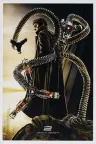
The four mechanical arms Octavius wears for most of the film were practical builds, not something layered on afterward. Each arm needed puppeteers working in sync with Molina’s own performance, sixteen people in total across all four, to keep the tentacles reading as an extension of him rather than a machine trailing behind him. Molina gave the arms their own names, Harry, Larry, Flo and Moe, with Harry and Larry handling the character’s feats of strength and Flo doing the finer work, lighting a cigar or lifting his glasses off his face.
THE FIGHT ON THE EL
THE SEQUENCE RAIMI STORYBOARDED FOR MONTHS BEFORE A CAMERA ROLLED
Raimi spent months in pre-production planning the elevated-train fight between Spider-Man and Doc Ock. Rather than shoot on a working New York line, the production filmed train exteriors in Chicago and built full train-car sets on soundstages in Culver City. Dykstra remembered the Chicago winter: “It was bitter for some of those guys. Trying to load a camera, you had to load it barehanded, and it was cold enough that everybody was wearing gloves.”
Molina had no prior wire or harness experience, so stunt double Ray Lykins covered the physically dangerous work. “Every day was just boom, boom, boom, boom, let’s get this real,” Lykins said of the shoot. Brad Martin, doubling Spider-Man, took some of the sequence’s hardest hits, including being driven through a train door: “I rung my bell. It could have rendered me unconscious for a moment, possibly.”
“This really was the heartbeat of the film, that it was about just the humanity of it all.”
Alfred Molina, on the train sequence
The fight ends with an unmasked, unconscious Peter carried back into the carriage by the passengers he just saved, who agree on the spot to keep his identity to themselves. Retrospective coverage has repeatedly called it one of superhero cinema’s best action sequences on that basis: the choreography matters less than what it buys the film, a moment where Spider-Man’s heroism is confirmed by ordinary people rather than by the plot alone.
THE COSTUME IN THE TRASH
WHY RAIMI MADE PETER QUIT BEING SPIDER-MAN
The film’s clearest statement of its own theme comes when Peter, worn down by the gap between his own life and Spider-Man’s, drops the costume in a trash can and walks away. Raimi has traced the scene back to the comics directly: “I was thinking about a great issue of Stan Lee’s Spider-Man comic book where he gets the flu. And he, for a time, is really weak.” Taking away Peter’s powers, not just his costume, let the film treat his exhaustion as a physical fact rather than a metaphor for one.
“To be responsible, you have to pay a price. It’s not easy. It’s not easy to do the right thing.”
Sam Raimi, on Spider-Man 2’s central theme
Kirsten Dunst and Tobey Maguire had dated during production of the first film and split before this one began, something Raimi has said he didn’t learn about until it was already over. “I actually had some worries about it… I was concerned they wouldn’t get the same chemistry back,” he said in 2007. It didn’t show on screen: “They really like each other, I think, very much. And that relationship probably just added to their ability to trust each other.”
THE REWATCH
A RECORD OPENING DAY, A LOWER TOTAL, AND THE OSCAR THAT FOLLOWED
Spider-Man 2 opened on Wednesday, 30 June 2004, to a $40.4 million first day, a record at the time for an opening day. Its Friday-to-Sunday weekend came to $88.2 million from 4,152 theatres, and the film finished with $373.6 million domestically and $786.4 million worldwide against a $200 million budget. Those totals actually sit below the original Spider-Man’s $139 million budget and its $403.7 million domestic, $804.5 million worldwide run two years earlier, a rare case of the better-reviewed sequel not quite matching its predecessor’s gross.
Reviews improved on an already strong original. Rotten Tomatoes lists Spider-Man 2 at 93% from critics, up from the first film’s 90%, with a critics’ consensus calling it “a nimble sequel that improves upon the original.” Audience response climbed to 82% from 67%, and Metacritic’s aggregate rose to 83 from 73. Released a year after X2 had already made the same case for its own franchise, the two films are still cited together as the point where critics stopped assuming a comic-book sequel would automatically be worse than what came before it.
Spider-Man 2 also won the Academy Award for Best Visual Effects at the 77th ceremony in 2005, awarded to John Dykstra, Scott Stokdyk, Anthony LaMolinara and John Frazier. For a first watch, it sits in the Marvel movies in release order guide, and it works best after the original Spider-Man, which sets up Peter and MJ’s unfinished relationship and Harry’s growing suspicion about his father’s killer.
QUICK ANSWERS
SPIDER-MAN 2 WATCH QUESTIONS
Do I need to watch anything before Spider-Man 2?
Yes. It’s a direct sequel to Spider-Man (2002) and assumes you know Peter and MJ’s unresolved relationship and Harry Osborn’s suspicion about his father’s killer, though it recaps the basics for a new viewer.
Is Spider-Man 2 connected to the MCU?
Not through its own story. It sits in the Marvel Marathon’s wider connected live-action scope alongside the other Spider-Man, Blade and X-Men films, tracked separately from central MCU continuity.
Which Marvel Marathon guides include Spider-Man 2?
It appears in the Marvel movies in release order guide. Marking it watched above updates your progress there and on the main tracker.
EDITORIAL NOTES
SOURCES AND UPDATES
Screenplay development, casting, production and box-office details are checked against contemporaneous and retrospective trade reporting, official awards records, and on-the-record cast and crew interviews, cited individually below.
- Box Office Mojo: Spider-Man 2 (2004) budget, opening weekend and total box office
- Rotten Tomatoes: Spider-Man 2 (2004) critic and audience scores and consensus
- Metacritic: Spider-Man 2 (2004) critic and user scores
- SlashFilm: an oral history of Spider-Man 2’s train fight scene
- SlashFilm: on Spider-Man 2’s screenplay development, from Gough and Millar through Chabon to Alvin Sargent
- Yahoo Entertainment: Alfred Molina on being cast as Doctor Octopus
- SuperHeroHype: Sam Raimi interview on Spider-Man 2’s themes and the “Spider-Man No More” sequence
- CinemaBlend: Spider-Man 2’s producers and crew on the pressure of following the original
- Film Stories: how Tobey Maguire’s Seabiscuit back injury nearly cost him Spider-Man 2
- Yahoo Lifestyle: Sam Raimi’s 2007 Sydney Morning Herald interview on Kirsten Dunst and Tobey Maguire’s relationship
- fxguide: Spider-Man 2’s win for Best Visual Effects at the 77th Academy Awards