MARVEL MARATHON DEEP DIVE
MAN-THING.
Marvel built Man-Thing as a theatrical horror film, then scrapped that release after rough test screenings and sent it to premiere on cable instead, the only film in this catalogue that never opened in a US cinema.
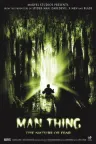
A THEATRICAL RELEASE THAT NEVER HAPPENED
HOW A SUMMER OPENING BECAME A SCI-FI CHANNEL PREMIERE
Marvel Enterprises and Artisan Entertainment built Man-Thing under the same production deal that had already delivered Blade II, Blade: Trinity and The Punisher, an arrangement covering more than a dozen Marvel characters across film and television. Lions Gate Entertainment bought Artisan outright in October 2003, absorbing Man-Thing along with the rest of Artisan’s Marvel slate while the film was still shooting in Sydney.
A joint Artisan and Marvel press release that same month still described a conventional cinema release: 27 August 2004, in theatres. Marvel Studios CEO Avi Arad called it “an unbelievably exciting project,” and Artisan executive vice president Patrick Gunn made the pitch explicit: “Man-Thing brings a chilling component not previously showcased in Marvel comic based films.”
That date slipped, then disappeared from the release calendar entirely. Test screenings are the reason usually given: audiences reportedly began walking out before the film had finished. Lions Gate dropped the US theatrical plan and sold the finished film to the Sci-Fi Channel instead, which aired it as a “Sci-Fi Original” on 30 April 2005. Cinema releases followed months later in Russia and the post-Soviet states, the United Arab Emirates and Spain, all after American audiences had already been able to watch it for free at home, a release pattern no other title in this catalogue shares.
A HORROR DIRECTOR HIRED FOR HORROR, THEN OVERRULED
WHY MARVEL WANTED THE MAN BEHIND THE LAWNMOWER MAN
Brett Leonard came to Man-Thing from outside the superhero genre entirely. His breakout film, The Lawnmower Man (1992), turned virtual reality into a body-horror premise years before the technology existed for consumers, and Virtuosity (1995) gave Russell Crowe his first lead role in an American studio film. Hiring a director with that background, for a character who is a swamp creature rather than a costumed hero, signalled an intention to make something closer to a monster movie than a superhero film.
Leonard has said that intention was real, and that it didn’t survive the production.
“That’s what I was reaching for. All of that got ripped out. It got fully ripped out so it became a straight-up monster movie, where it was like there was a monster in the swamp, the sheriff goes in, tries to find it, and again, not much happens.”
Brett Leonard, on his original take on Man-Thing
Leonard has also described a darker ending he wanted, one in which almost everyone but the creature itself dies. The version that reached screens keeps a simpler shape instead: the sheriff survives, the love interest survives, and Man-Thing dissolves back into the swamp after killing the villain. Leonard has declined to say who made those changes, referring only to “the powers that be.”
A COMIC BUILT ON DREAD, ADAPTED AS A SLASHER
WHAT SURVIVED FROM STEVE GERBER’S RUN, AND WHAT DIDN’T
In the comics, Ted Sallis is a biochemist who injects himself with an attempted recreation of the super-soldier serum and crashes into the Florida Everglades while fleeing armed agents, at the exact spot where the swamp’s mystic energy remakes him as the Man-Thing. Steve Gerber’s run on the character, starting with Adventure into Fear #11 in 1972, used that origin as a way into horror stories about environmental destruction, addiction, prejudice and grief, built around a creature that cannot speak and can only react to the fear and pain of whoever it meets. Gerber’s own caption-box line for the character became its most quoted phrase: “Whatever knows fear burns at the Man-Thing’s touch.”
Screenwriter Hans Rodionoff has said he wrote the film as a lifelong reader of Gerber’s comics, and chose to keep Man-Thing itself wordless and largely offscreen on purpose, comparing the approach to a different horror classic: “the Man-Thing is a malignant force of nature. The shark didn’t talk in Jaws. I approached the Man-Thing in a similar way.” His script drops the biochemist backstory altogether. Ted Sallis becomes a Seminole shaman murdered by an oil company for his land, and never appears on screen as anything other than the creature, which removes the comics’ science-gone-wrong premise along with him.
The production also worked in a private tribute to the character’s history: supporting roles are named Steve Gerber and Mike Ploog, the artist on Man-Thing’s own solo series starting in 1974, alongside a small part played by Leonard himself as Val Mayerik, Gerber’s regular collaborating artist on the strip’s earliest issues. None of the three namesakes amounts to more than a minor, forgettable role.
AN AUSTRALIAN CAST PLAYING LOUISIANA
JACK THOMPSON, A YOUNG RACHAEL TAYLOR, AND A WRESTLER IN THE SUIT
Budget considerations moved the production away from its intended Louisiana setting and into Sydney and its surrounding wetlands, with a cast made up almost entirely of Australian actors playing a story set in the American South, Southern accents across the board, a mismatch reviewers noted repeatedly on release.
The best-known name in the cast was Jack Thompson, a veteran of Australian cinema named best supporting actor at Cannes for Breaker Morant (1980), who had appeared two years earlier in Star Wars: Attack of the Clones. He plays Frederic Schist, the oil tycoon at the centre of the film’s plot. Rachael Taylor, cast as schoolteacher Teri Richards, took the role not long after her own screen debut in a 2004 TV miniseries, and went on to larger roles in Transformers (2007) and Marvel’s own Jessica Jones.
Inside the creature suit was Conan Stevens, an Australian former professional wrestler standing over seven feet tall, cast for his size rather than any acting background, in a part written with almost no dialogue. Stevens later reached a much larger audience playing Gregor “The Mountain” Clegane in the first season of Game of Thrones, before a scheduling conflict with The Hobbit trilogy took him off the role after two episodes.
THE REWATCH
THE LOWEST SCORE IN THE CATALOGUE, AND A FILM EVEN BAD-MOVIE FANS FORGOT
Man-Thing never had a US opening weekend to report, because it never played an American cinema. Its international theatrical run, spread across Russia and the post-Soviet states, the United Arab Emirates and Spain, grossed a combined $1.1 million against a $5 million budget, all of it after the Sci-Fi Channel had already aired the film for free at home. Reviews were almost uniformly negative: Rotten Tomatoes lists a 14% critics’ score against a 14% audience score, among the lowest of any film in this catalogue.
What sets Man-Thing apart even inside that bracket is how little attention it draws. Retrospective coverage of Marvel’s worst-reviewed films tends to single it out specifically for being forgotten rather than argued over. It has never built the kind of ironic, so-bad-it’s-good following that trails other low-scoring titles in this catalogue, and mostly turns up in pieces written by critics working through Marvel’s full filmography rather than being sought out on its own.
The character has fared better than this film did. Man-Thing’s 2022 appearance in Marvel Studios’ Werewolf by Night special presentation, shot largely in black and white as an homage to Universal’s classic horror pictures, drew the kind of praise this version never received. For a first watch, Man-Thing sits in the Marvel movies in release order guide between Elektra and Fantastic Four, in the mid-2000s stretch where Marvel’s non-X-Men, non-Spider-Man properties were still being tested, and mostly failing, three years before Iron Man reset the studio’s own approach.
QUICK ANSWERS
MAN-THING WATCH QUESTIONS
Do I need to watch anything before Man-Thing?
No. It’s a stand-alone story with no ties to any other film in this catalogue and assumes no prior context.
Why doesn’t Man-Thing have a US opening weekend listed?
Because it never had one. Lions Gate pulled the planned US theatrical release after poor test screenings and premiered the film on the Sci-Fi Channel on 30 April 2005 instead. Its only cinema runs came later, in Russia, the United Arab Emirates and Spain.
Which Marvel Marathon guides include Man-Thing?
It appears in the Marvel movies in release order guide, between Elektra and Fantastic Four. Marking it watched above updates your progress there and on the main tracker.
EDITORIAL NOTES
SOURCES AND UPDATES
Production, casting, comics-history and reception details are checked against contemporaneous trade reporting, official studio materials, on-the-record cast and crew interviews, and aggregator scores, cited individually below.
- SuperHeroHype: Man-Thing’s original theatrical release date, with quotes from Avi Arad and Patrick Gunn
- Collider: a look back at Man-Thing’s scrapped theatrical release and Sci-Fi Channel premiere
- ScreenGeek: retro review including Brett Leonard’s account of his original vision and the studio interference
- CBR: Hans Rodionoff interview on adapting Man-Thing from Steve Gerber’s comics
- Rotten Tomatoes: Man-Thing (2005) critic and audience scores
- Box Office Mojo: Man-Thing (2005) territory release dates and box office
- CBR: 20 years later, Man-Thing as one of Marvel’s most forgotten box-office flops
- CBR: Man-Thing’s comics legacy and Werewolf by Night’s redemption of the character
- National Portrait Gallery of Australia: Jack Thompson biography, on Breaker Morant and Cannes
- SlashFilm: on Conan Stevens playing The Mountain in Game of Thrones season one