MARVEL MARATHON DEEP DIVE
IRON MAN
3.
Robert Downey Jr. brought in Kiss Kiss Bang Bang’s Shane Black to open Phase Two, and Black turned Marvel’s most notorious villain into Ben Kingsley playing a hired fraud, a twist fans never forgave.
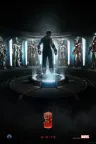
A COMEBACK WRITER FOR MARVEL’S FIRST FILM AFTER THE AVENGERS
WHY ROBERT DOWNEY JR. BROUGHT SHANE BLACK IN TO OPEN PHASE TWO
Marvel confirmed in February 2011 that Shane Black would write and direct Iron Man 3, putting the first film to go into production after The Avengers in the hands of a director with no prior screen credit on the franchise. Black had directed Robert Downey Jr. in 2005’s Kiss Kiss Bang Bang, a role frequently cited as the turning point in Downey’s career comeback after a well-documented period of personal trouble, and Downey is reported to have pushed directly for Black’s hiring. Downey has said Black’s connection to the series actually predates that credit: during the first Iron Man’s production, he and Jon Favreau brought Black in uncredited for help with Tony Stark’s press-conference speech near the end of the film, which Downey says “all came from Shane Black.” Of finally getting Black onto an Iron Man film in his own right, Downey said: “I adore him. I’ve been a fan of Shane Black since I saw ‘Lethal Weapon,’” calling the collaboration “one of my favorite working experiences.”
Marvel built the film specifically as the opening chapter of what Kevin Feige was by then calling Phase Two, the slate running from this film through Avengers: Age of Ultron. Feige was careful to frame it as its own story rather than a direct continuation of the ensemble: “Iron Man 3 doesn’t feature any of the other Avengers, or Nick Fury showing up,” he said, adding that the film would use that space to dig further into Stark himself: “It’s not a serious movie, but we seriously dig into exploring more of Tony.” Black and co-writer Drew Pearce built that exploration around Warren Ellis’s 2005 to 2006 Extremis comic arc, reworking its central idea, a biotech regeneration formula turned into a weapon, as the engine for an original plot rather than adapting the comic’s story beat for beat.
A VILLAIN MARVEL HAD NEVER BEEN ABLE TO USE STRAIGHT
WHY BLACK AND PEARCE TURNED THE MANDARIN INTO AN ACTOR FOR HIRE
The film’s marketing built Ben Kingsley’s Mandarin up as a classic terrorist mastermind, then revealed partway through that the figure behind the televised threats was Trevor Slattery, a washed-up English actor hired to read scripted broadcasts while Guy Pearce’s Aldrich Killian ran the real operation behind Extremis. Drew Pearce has said the idea arrived almost by accident during a writing session with Black, describing months spent working through the script together before the pitch landed: “Shane and I basically came up with it in his gigantic mansion in LA where we sat for ten hours a day for three months.”
“Shane, what if the Mandarin is an actor?”
Drew Pearce, recalling the writing-room moment that produced Iron Man 3’s central twist
Pearce has been candid that the specific version of that idea surprised even him once it was written: “I did not come back from the bathroom and pitch an alcoholic, British lovie with a pair of hookers in his bed and an incredibly detailed history in local British theater, but that is weirdly what it turned out to be.” Both writers have tied the choice back to the character’s own history rather than treating it as a twist for its own sake: the comics’ Mandarin carried decades of what retrospective coverage describes as yellow-peril stereotyping that Marvel Studios had avoided importing directly into any earlier film. Black has said the fabricated-villain structure let the story comment on manufactured fear more broadly, calling it a way to “show how people are complicit in being frightened,” adding that “there’s a lot of fear that’s generated toward very available and obvious targets, which could perhaps be directed more intelligently at what’s behind them.”
The reveal split the audience roughly along the line the marketing had drawn. Viewers expecting a dangerous, faithful Mandarin felt misled by the trailers, while others praised the subversion and Kingsley’s performance as Slattery specifically, and the reaction carried a racial dimension beyond the twist mechanics alone, since casting Kingsley, an actor of British and Indian rather than Chinese heritage, as the face of a character Marvel had just reworked away from its original stereotype left the film still navigating that ground rather than clearing it. Marvel’s own co-president Louis D’Esposito acknowledged the studio had anticipated some pushback: “We thought there would be a little bit of a backlash, but the twist was so wonderful and Ben Kingsley is such a great actor that we thought that would overcome. We don’t want to piss off our fans, but it’s impossible to please everyone.” Marvel followed up in February 2014 with the Marvel One-Shot All Hail the King, built around Trevor Slattery and the fallout from this reveal; Black has since called it close to a direct apology, saying “Marvel saw so many negative things they made a whole other movie just to apologize.” That short is covered separately elsewhere on this site, but Pearce has offered a different framing of his own intentions for it, describing the story as a deliberate extension of the Mandarin and Ten Rings material already seeded across the Iron Man films rather than only a course correction.
FROM TWENTY-TWO SUITS ON PAPER TO THIRTY-SIX ON SCREEN
HOW THE HOUSE PARTY PROTOCOL FINALE ACTUALLY GOT BUILT
The film’s climax deploys dozens of remote-piloted Iron Man armors at once, a sequence Tony names on-screen as the “House Party Protocol.” Weta Digital led the sequence across roughly 500 shots, and the number of suits on screen grew well past what the studio first planned: Weta was initially asked to build ten hero suits and twelve background suits, twenty-two in total, a number that grew during production to twelve hero suits and twenty-four background suits, accounting for the thirty-six armors that appear in the finished battle. Digital Domain supplied the foundation designs that Weta and the film’s other vendors, including Scanline, Trixter, Framestore and Method Studios, built outward from for their own sequences.
Black has connected the sheer number of suits to a theme he wanted running underneath the spectacle rather than separate from it, framing Tony’s armor-building as compulsive rather than simply heroic: “The addictive quality of Tony’s obsessive need to keep building suits and suits and suits, and reinvent himself,” he said, treating House Party Protocol’s scale as the visible result of that compulsion rather than only a bigger action set piece. Elsewhere in the same production, Trixter handled the film’s separate suit-up sequence for the Mark XLII armor, splitting its digital model into 24 individually tracked pieces that fly onto Tony’s body in sequence, a shot built specifically to accommodate Downey’s own unchoreographed movement on a motion-capture stage rather than a fixed animation pass.
A BLOCKBUSTER HERO WHO ACTUALLY HAS PANIC ATTACKS
TONY STARK’S ANXIETY, AND WHY CRITICS TOOK IT SERIOUSLY
Iron Man 3 opens with Stark still dealing with the aftermath of the Battle of New York, giving him recurring, visibly debilitating panic attacks rather than simple brooding: insomnia, intrusive recollection of the wormhole he flew through, and an attack triggered mid-film by a child’s question about the invasion that sends him running from a bar and into his suit. Clinical psychologist Travis Langley, writing for Psychology Today, argued the portrayal tracks closely enough to read as a genuine clinical case rather than vague movie shorthand: “Anthony Stark appears to meet the full criteria for posttraumatic stress disorder,” he wrote, pointing to Stark’s avoidance behavior, hypervigilance and intrusive memories of “the certainty of his own imminent death” as satisfying that pattern rather than a single symptom played for effect.
That same analysis didn’t treat the film as a flawless depiction. Langley noted that real PTSD “doesn’t always manifest the same way,” and that a panic attack resolving once a child distracts Stark compresses genuine trauma recovery into something far quicker than it would actually be. The choice still registered as unusual for the genre at the time: a tentpole blockbuster built its hero’s central arc around a named, recognisable mental health condition rather than reducing trauma to a single flashback scene, and the film resolves that arc by having Stark destroy his collection of armors and undergo surgery to remove the shrapnel lodged near his heart, retiring the arc reactor that had defined the character since 2008.
THE REWATCH
A RECORD-SETTING OPENING FOR MARVEL’S FIRST FILM AFTER THE AVENGERS
Iron Man 3 opened to $174.1 million domestically, the second-biggest domestic opening weekend at that point behind only The Avengers the year before, and finished with $409 million in the US and $1.215 billion worldwide, making it Marvel Studios’ first billion-dollar film outside an ensemble team-up. Reviews were strong without matching The Avengers: Rotten Tomatoes lists a 79% critics’ score, with its consensus crediting Downey’s “charismatic” lead performance and “impressive action sequences” for “a witty, entertaining adventure.” Metacritic’s more measured 62 still marked an improvement on Iron Man 2’s reception three years earlier.
The film closed out Tony Stark’s standalone trilogy by stripping him of both the shrapnel and the arc reactor that had defined the character since the first film, a deliberately final-feeling note for a storyline Marvel would nonetheless keep extending well beyond this one. For a first watch, Iron Man 3 sits in the Marvel movies in release order guide directly after The Amazing Spider-Man, opening Phase Two as the first Marvel Studios film built in the shadow of The Avengers’ success.
QUICK ANSWERS
IRON MAN 3 WATCH QUESTIONS
Do I need to watch The Avengers before this one?
Yes. Iron Man 3 opens with Tony Stark still having panic attacks tied to the Battle of New York, and that trauma drives most of his arc here.
Is the Mandarin the real villain in Iron Man 3?
No. Ben Kingsley’s Mandarin turns out to be Trevor Slattery, an actor hired to read scripted threats while Guy Pearce’s Aldrich Killian runs the actual Extremis operation behind him.
Which Marvel Marathon guides include Iron Man 3?
It appears in the Marvel movies in release order guide, directly after The Amazing Spider-Man. Marking it watched above updates your progress there and on the main tracker.
EDITORIAL NOTES
SOURCES AND UPDATES
Development, casting, production, critical reception and box-office details are checked against contemporaneous trade reporting, visual-effects trade coverage and on-the-record cast and crew interviews, cited individually below.
- Collider: Shane Black’s hiring, the Extremis comic basis and the reasoning behind the Mandarin twist
- ScreenRant: Robert Downey Jr. on Shane Black’s uncredited work on the first Iron Man and directing Iron Man 3
- ScreenRant: Drew Pearce on pitching the Mandarin-as-actor twist to Shane Black
- GamesRadar: Shane Black defending the Mandarin twist’s thematic reasoning
- SlashFilm: Kevin Feige on Iron Man 3 opening Phase Two and its tone
- Starburst Magazine: Louis D’Esposito’s on-record comments to IGN on the Mandarin backlash
- ComicBookMovie.com: Shane Black on All Hail the King as Marvel’s response to the backlash
- fxguide: the House Party Protocol’s suit count and the visual-effects studios behind it
- CBR: Shane Black and Drew Pearce reflecting on Iron Man 3’s themes and reception
- Psychology Today: Travis Langley’s clinical analysis of Tony Stark’s PTSD in Iron Man 3
- Box Office Mojo: Iron Man 3 opening weekend, domestic and worldwide box office
- Rotten Tomatoes: Iron Man 3 critic score and consensus
- Metacritic: Iron Man 3 critic score