MARVEL MARATHON DEEP DIVE
GHOST
RIDER.
Ghost Rider stalled across three studios for over a decade before Nicolas Cage, a fan of the comic since childhood, got the role, and its flaming skull was built from a scan of his own face.
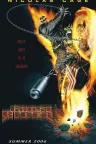
A DECADE STALLED ACROSS THREE STUDIOS
HOW GHOST RIDER MOVED FROM DIMENSION TO COLUMBIA BEFORE A FRAME WAS SHOT
Marvel first set Ghost Rider in development in 1992, and the project drifted through most of the decade without a script that stuck. Producer Gale Anne Hurd picked it up in 1997 and commissioned a screenplay from Jonathan Hensleigh, fresh off Die Hard with a Vengeance and Armageddon. That draft went nowhere. David S. Goyer, who had just co-written Blade, took over next and wrote a version closer to The Road Warrior than to a conventional origin story: a wandering spirit doomed to walk the earth, scripted with an R rating in mind rather than a family audience.
In 2000 the rights moved to Dimension Films, co-financing with Crystal Sky Entertainment, and Stephen Norrington, fresh off directing Blade, signed on to direct Goyer’s script. Johnny Depp was courted for the lead and passed. Norrington’s version never reached a soundstage. Within two years the project moved again, this time to Columbia Pictures in a rights turnaround, with Sony keen to repeat what it had just done with Spider-Man. Screenwriter Shane Salerno took his own pass at Goyer’s script in 2003.
Mark Steven Johnson, who had just directed Daredevil for Fox, joined Ghost Rider that same year and scrapped Salerno’s draft to write his own. Nicolas Cage had been attached to the role in some form since at least 2001, waiting out two more studios and two more screenwriters before a director finally committed to making the film with him in it. Production began in 2005, thirteen years after Marvel first floated the idea, for a release that reached theatres on 16 February 2007.
A ROLE HE’D BEEN READING TOWARD SINCE HE WAS EIGHT
NICOLAS CAGE’S OWN CASE FOR PLAYING JOHNNY BLAZE
Cage has said the comic that actually shaped him as a kid wasn’t the one most people assume. His son is widely known to be named Kal-El, after Superman, but Cage has said Superman was never his childhood hero: “The comic that affected me was Ghost Rider, because I liked the monsters and I felt sorry for the Hulk and the Ghost Rider.” By the time Johnson joined the production in 2003 there wasn’t much of a casting search left to run.
“There was never talk of anyone else playing Johnny Blaze.”
Mark Steven Johnson, on casting Nicolas Cage
Johnson has described Cage as the character’s biggest fan long before he had the job, down to a tattoo of Ghost Rider’s skull Cage had already had inked onto his arm. On set, Johnson let that fandom steer the performance past the obvious choices, including small, odd character beats Cage contributed himself: Johnny Blaze eating jellybeans out of a martini glass instead of drinking, and preferring Karen Carpenter’s records to rock and roll, details meant to sell a man whose body keeps surviving things that should have killed him.
Asked directly to compare Ghost Rider with the character people assume meant more to him, Cage didn’t equivocate: “I do genuinely think that Ghost Rider is a better match for me.”
A CHARACTER BUILT WITH SOFTWARE THAT DIDN’T EXIST YET
HOW SONY PICTURES IMAGEWORKS SOLVED A FULLY CG FLAMING HEAD
Making Ghost Rider’s skull work as a performance rather than a glowing prop required tools the production had to build itself. Effects animation supervisor Patrick Witting and his team at Sony Pictures Imageworks found the commercial fire-simulation software available in 2006 wasn’t flexible enough for what they needed, so they built a hybrid system of their own: “Maya’s fluid engine was the core fluid solver, but it was limited in its emitter and colliders. So, we used Houdini to drive them, and we wrote a custom Maya plug-in to read and interpret that Houdini data on every frame.”
“It was all about control and directability of the fire.”
Patrick Witting, effects animation supervisor, on building Ghost Rider’s custom fire tools
The skull, neck, eyes and hands were each simulated separately and tied back to the character’s motion, with flame density shifting by scene. To keep the fully digital head from reading as a detached effect, the design was built in part from an actual scan of Cage’s own skull. Visual effects supervisor Kevin Mack’s own verdict on the work doubles as a fair summary of what the production was attempting: a fully CG lead character, rendered convincingly enough to carry close-ups, at a moment when almost nothing in the genre had tried it. “CG fire and fluids tend to look unreal on screen, but I think we broke it with this project,” he said. “We had complete control over its movement and color, all the while keeping it photoreal. I consider this our greatest achievement.”
A GUNSLINGER, A REPORTER AND A DEVIL WHO’D RIDDEN THIS ROAD BEFORE
CASTING EVA MENDES, SAM ELLIOTT AND PETER FONDA
Eva Mendes took Roxanne Simpson, Johnny Blaze’s childhood love and, in this version, a television reporter rather than the blonde, blue-eyed character from the comics. Mendes has said she worried fans wouldn’t accept a change that visible, and made a point of asking Johnson upfront not to write her as “just the chick in the movie.” What she got instead was a character with her own career and her own stake in the plot, rather than a love interest waiting at the finish line.
Sam Elliott was, by Johnson’s own account, the first choice for Carter Slade, the retired Caretaker who mentors Blaze through his first transformation, a role barely sketched in the comics that Johnson expanded specifically around what Elliott could do with it. Wes Bentley took the film’s central antagonist, Blackheart, playing him human-scaled for most of the running time before a late transformation into something closer to the comics’ demon.
Peter Fonda’s casting as Mephistopheles carried its own history. Decades earlier, Fonda had ridden a customised Harley-Davidson through Easy Rider (1969), and Ghost Rider’s own production modelled Johnny Blaze’s motorcycle directly on that bike before its demonic transformation into something with a skull for a headlight and chains for forks, handing the role of the devil buying Blaze’s soul to the actor who’d ridden the original.
“I had read a few of them before, but I thought regardless of what the guy who wrote the comics had designed here, it was up to me to put it on the screen. Let me tell you, nobody has played the Devil quite like I do. Oh, man, I loved it. It was really cool.”
Peter Fonda, on playing Mephistopheles
The devil at the centre of that story is also part of why Ghost Rider’s PG-13 rating drew the kind of scrutiny Daredevil, Johnson’s previous Marvel film, had already drawn four years earlier. Goyer’s earliest script had been written with an R rating in mind, and the version that reached theatres was reshaped toward a wider audience instead. Johnson, for his part, says he expected to lose more than he did to the rating: “I was actually really happy and surprised… because I was expecting to have to cut stuff out so it wouldn’t be an R.”
THE REWATCH
A PRESIDENTS’ DAY RECORD, A ROUGH SCORE, AND A SEQUEL CAGE STILL DEFENDS
Ghost Rider opened on 16 February 2007, timed to the Presidents’ Day long weekend, to $45.4 million from 3,619 theatres, beating the previous four-day Presidents’ Day record Sony’s own 50 First Dates had set in 2004. On a $110 million budget it went on to gross $115.8 million domestically and $228.7 million worldwide, a comfortable commercial result whatever reviews said about it.
Reviews ran the other way. Rotten Tomatoes lists a 28% critics’ score against a 48% audience score, and Metacritic’s aggregate sits at 35. Sony also issued an unrated Extended Cut on DVD that year, running 123 minutes against the theatrical version’s 110, adding small scenes of character backstory rather than restoring anything that had pushed the rating higher.
Cage and Sony returned five years later for Ghost Rider: Spirit of Vengeance (2012), directed by Mark Neveldine and Brian Taylor rather than Johnson, on roughly half the original’s budget and a worldwide gross of $132.6 million. Sony’s hold on the character didn’t last much longer: the film rights reverted to Marvel Studios in 2013, and no further Cage-led instalment has followed. Cage has stayed candid about the original film since, consistently arguing its PG-13 cut undersold what Goyer had actually written: “Had Ghost Rider been made in R-rated format, the way they had the guts to do with Deadpool… I’m fairly certain it would be enormously successful,” he said in 2018. For a first watch, Ghost Rider is the first 2007 release in the Marvel movies in release order guide, arriving in that connected scope just after Blade: The Series and X-Men: The Last Stand.
QUICK ANSWERS
GHOST RIDER WATCH QUESTIONS
Do I need to watch anything before Ghost Rider?
No. It’s a self-contained origin story and works as a starting point on its own, separate from the MCU’s own continuity.
Is Ghost Rider connected to the MCU?
Not through its own story. Sony held the film rights to the character from the mid-2000s until they reverted to Marvel Studios in 2013, so this version sits in Marvel Marathon’s wider connected live-action scope, tracked separately from central MCU continuity.
Which Marvel Marathon guides include Ghost Rider?
It appears in the Marvel movies in release order guide, as the first 2007 release in that connected scope. Marking it watched above updates your progress there and on the main tracker.
EDITORIAL NOTES
SOURCES AND UPDATES
Development, casting, visual-effects and box-office details are checked against contemporaneous and retrospective trade reporting, on-the-record cast and crew interviews, and aggregator scores, cited individually below.
- Box Office Mojo: Ghost Rider (2007) budget, opening weekend and total box office
- Rotten Tomatoes: Ghost Rider (2007) critic and audience scores
- Metacritic: Ghost Rider (2007) critic and user scores
- Wicked Horror: Script to Pieces, on Ghost Rider’s decade-plus development history before Mark Steven Johnson
- JoBlo: Mark Steven Johnson on Ghost Rider’s PG-13 rating and Nicolas Cage’s creative input
- Animation World Network: on Sony Pictures Imageworks’ custom fire-simulation tools for Ghost Rider
- HuffPost: Nicolas Cage on Ghost Rider versus Superman and his childhood reading of the comic
- Yahoo Entertainment: Nicolas Cage on why Ghost Rider should have been rated R, September 2018
- SuperHeroHype: Eva Mendes on playing Roxanne Simpson in Ghost Rider
- SuperHeroHype: Peter Fonda on playing Mephistopheles in Ghost Rider
- Rotten Tomatoes Editorial: Box Office Guru Wrapup on Ghost Rider’s record Presidents’ Day weekend
- Box Office Mojo: Ghost Rider: Spirit of Vengeance (2012) budget and worldwide box office
- SlashFilm: Marvel Studios once again controls the film rights to Ghost Rider and Blade