MARVEL MARATHON DEEP DIVE
RISE OF THE
SILVER SURFER.
Fox rushed the Fantastic Four sequel into theatres two years after the original, swapped Doug Jones’s own voice for Laurence Fishburne’s, and turned Galactus into a storm cloud critics never forgave.
A VILLAIN TOO BIG FOR THE BUDGET
WHY MARVEL’S MOST CELEBRATED COSMIC VILLAIN BECAME A STORM CLOUD
The sequel built its threat around a loose version of Galactus, the planet-devouring entity Stan Lee and Jack Kirby introduced across Fantastic Four #48 through #50 in 1966, a run still generally regarded as the character’s defining comics appearance. Rather than put the comics’ armored giant on screen, the film kept Galactus almost entirely unseen and resolved him instead as a vast, roiling storm cloud that consumes a planet from orbit.
Longtime readers treated the choice as close to a betrayal. Galactus’s design, purple helmet and all, is one of the more enduring pieces of visual imagery in Marvel’s history, and the film never shows it. Director Tim Story has since said the decision wasn’t really his.
“The ones in charge were afraid of what that could be because, you have to remember, even Marvel has gone through quite cleverly and successfully introduced us to superheroes being in space, and at the time that was never dealt with. So as a being from space, there were those in charge who weren’t ready for what that could be. And, so, you know, that’s not the interpretation it should have been.”
Tim Story, director, 2023
Story has also said the cloud was meant to be a partial reveal rather than a final answer, with a fuller version of the character planned for a separate Silver Surfer film Fox already had in development. That spinoff was never made, so the storm cloud stayed the only Galactus this run of Fantastic Four films ever delivered.
A PERFORMANCE RECORDED, THEN REPLACED
DOUG JONES BUILT THE SILVER SURFER TWICE AND ONLY KEPT HALF THE CREDIT
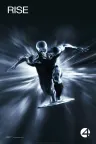
Doug Jones, a performer with a career built on physically demanding, heavily disguised roles, played the Silver Surfer on set in a rubber suit rigged with tracking markers, giving Weta Digital’s effects team a real performance to build the finished chrome figure on top of rather than animating one from nothing. During filming, Jones also recorded the character’s dialogue himself.
On 19 April 2007, Fox confirmed to trade press that Laurence Fishburne, not Jones, would voice the character. By Jones’s own account the decision landed within about two days of his own vocal work wrapping.
“No actor wants to see a portion of their performance taken away.”
Doug Jones, 2007
Story’s own explanation, given before the backlash to the swap had fully set in, framed it as a straightforward creative call. He described talking with Fishburne about Galactus and the Silver Surfer months before shooting began and finding him “a complete fan” of the material, then asked rhetorically: “who, aside from James Earl Jones, has a more powerful voice? He was perfect and I didn’t have to convince anyone.” Ioan Gruffudd, who worked opposite Jones for the whole shoot, has since made a point of crediting the performance that never actually changed: “He was literally there creating this character which they then took away and made the CGI version of the Silver Surfer.”
A 110-PERSON CREW, AND A SUIT THAT FINALLY GOT EASIER
HOW WETA BUILT THE CHROME, AND HOW THE THING GOT A BETTER SUIT
Weta Digital handled roughly 300 Silver Surfer shots with a credited crew of about 110 artists, working between late January and 20 April 2007. Visual effects supervisor Eric Saindon kept Jones’s performance on set rather than shoot against an empty stage, for practical reasons as much as artistic ones: “it’s much easier to paint out a character who is on set… than to try to make bad acting work with a clean plate.”
Getting the chrome itself right took deliberate engineering, to avoid reading as a rerun of Terminator 2’s liquid-metal T-1000. Weta’s artists dialed back reflectivity, added occlusion and self-reflection, and built new software to preserve skin-like volume and wrinkling beneath the surface, aiming for something closer to liquid than mirror.
Michael Chiklis returned as Ben Grimm under a redesigned Thing suit, an improvement he has credited directly to the production learning from how punishing the original had been. “In the second incarnation, we redesigned the suit,” he said at New York Comic Con in 2025. “It was much better.” Ioan Gruffudd, Jessica Alba, Chris Evans and Julian McMahon also returned as Reed Richards, Sue Storm, Johnny Storm and Victor Von Doom.
A WEDDING INTERRUPTED, AND A RELEASE DATE NOBODY MOVED
THE SEQUEL FOX GREENLIT BEFORE THE FIRST FILM HAD EVEN FINISHED PLAYING
The script kept the first film’s light, ensemble-comedy tone rather than darken it, building its plot around Reed and Sue’s wedding, which the Silver Surfer interrupts mid-ceremony to warn Earth of Galactus’s approach. Doctor Doom, left for dead at the end of the first film, returns, and the team works with him again out of necessity rather than trust.
Fox put the sequel into theatres on 15 June 2007, just under two years after the original’s July 2005 release, a tight turnaround for an effects-driven studio tentpole. Chris Evans later said the cast read the studio’s silence after release as a bad sign for a third film, long before any formal word came: “We had all planned on doing [a third film], but if there were going to be a third, I think a week after the second one was released we would have heard.” The budget grew to a reported $130 million, up from the first film’s $100 million.
THE REWATCH
A SMALLER GROSS, A ROUGH SCORE, AND A QUIET END TO THE SERIES
Rise of the Silver Surfer opened on 15 June 2007 to $58.1 million from 3,959 theatres, ahead of the first film’s $56.1 million opening. The bigger start didn’t hold. The sequel finished with $131.9 million domestically and $301.9 million worldwide, behind the original’s $154.7 million domestic and $333.5 million worldwide totals, a decline on a larger budget.
Reviews landed in roughly the same mixed territory as the first film’s. Rotten Tomatoes lists a 38% critics’ score from 173 reviews against a 51% audience score, with a critics’ consensus that reads: “While an improvement on its predecessor, Fantastic Four: Rise of the Silver Surfer is nevertheless a juvenile, simplistic picture that has little benefit beyond its special effects.” Metacritic’s aggregate sits at 45. Inside that verdict, the Silver Surfer specifically drew the warmest notice the film received, and retrospective coverage keeps returning to the same point. “The Silver Surfer is by far the best part of the film,” Collider wrote in a 2024 reassessment.
None of that was enough to keep the series going. Fox had a third film and a Silver Surfer spinoff, scripted by J. Michael Straczynski, both in development before release. Straczynski later summed up what happened to his script plainly: “while the movie wasn’t exactly a box office failure, it wasn’t the success that it needed to be for Fox to move forward with it.” Neither project reached production, and Fox left the Tim Story-directed series there, rebooting the franchise with an entirely new cast in 2015, eight years later. Gruffudd has since said the four leads assumed a third film was coming: “The mind-set was that we were going to do three… but these decisions are beyond my control.” For a first watch, Rise of the Silver Surfer sits in the Marvel movies in release order guide, directly after Spider-Man 3, closing out the Tim Story era before the franchise went quiet for the better part of a decade.
QUICK ANSWERS
FANTASTIC FOUR: RISE OF THE SILVER SURFER WATCH QUESTIONS
Do I need to watch the 2005 Fantastic Four before this one?
Yes. It assumes you already know the team and brings back Doctor Doom from the ending the first film set up, though it recaps enough for a new viewer to follow.
Is Rise of the Silver Surfer connected to the MCU?
Not through its own story. It sits in the Marvel Marathon’s wider connected live-action scope alongside the first Fantastic Four film and the other Fox-era titles, tracked separately from central MCU continuity.
Which Marvel Marathon guides include Rise of the Silver Surfer?
It appears in the Marvel movies in release order guide, directly after Spider-Man 3. Marking it watched above updates your progress there and on the main tracker.
EDITORIAL NOTES
SOURCES AND UPDATES
Production, casting, visual-effects and box-office details are checked against contemporaneous and retrospective trade reporting, official studio materials, on-the-record cast and crew interviews, and aggregator scores, cited individually below.
- Box Office Mojo: Fantastic Four: Rise of the Silver Surfer (2007) budget, opening weekend and total box office
- Rotten Tomatoes: Fantastic Four: Rise of the Silver Surfer critic and audience scores and consensus
- Metacritic: Fantastic Four: Rise of the Silver Surfer critic and user scores
- CBR: Tim Story explains why Galactus became a storm cloud in Rise of the Silver Surfer
- ScreenRant: why the planned Silver Surfer spinoff, scripted by J. Michael Straczynski, was cancelled
- ComingSoon.net: Tim Story on casting Laurence Fishburne to voice the Silver Surfer (2007)
- Rotten Tomatoes Editorial: Ioan Gruffudd on Doug Jones’s on-set Silver Surfer performance
- Animation World Network: Weta Digital on building the Silver Surfer’s visual effects
- Popverse: Michael Chiklis on the redesigned Thing suit in Rise of the Silver Surfer, New York Comic Con 2025
- Looper: why Fantastic Four 3 and the Silver Surfer spinoff were never made, with Chris Evans’s account
- Collider: retrospective on Rise of the Silver Surfer, on the Silver Surfer as the film’s best element
- Yahoo Entertainment: Ioan Gruffudd on why a third Fantastic Four film never happened, from his Vulture interview